• September 2012

The Future of Education

“Knowledge speaks, but wisdom listens,” rock legend Jimi Hendrix famously said.

“Education is not the filling of a pail, but the lighting of a fire,” said literary icon William Yeats.

“Education is the most powerful weapon which you can use to change the world,” insisted Nelson Mandela.

What is the future of education? With these big ideas leading the way, we dedicate the September 2012 issue of Be Inkandescent magazine to discovering the answer. Scroll down to learn about some of the newest ideas, hottest education companies, and the cutting-edge innovators who are changing the way education operates.

Also in this issue:

  • We thank David Edward Byrd, the famous 1960s rock artist, for granting us permission to run his Hendrix poster above, and also for taking the time to do a Q&A with his former art student from Pratt Institute, Michael Gibbs, on The Art of Teaching Art.
  • Want to change the world? There’s nothing to it, says author David Bornstein in his book about the power of big ideas. Our new social entrepreneur columnist Beverly Schwartz introduces us to Aleta Margolis, a woman who is putting Bornstein’s widsom to work at her Center for Inspired Teaching.

We leave you with this parting thought from Thomas Edison: “If we all did the things we are capable of doing, we would literally astound ourselves.”

Here’s to your lifelong learning. — Hope Gibbs, publisher,
Be Inkandescent magazine • president, InkandescentPR • founder, InkandescentNetworkingnew! InkandescentSpeakers.com

Three Edu-preneurs Give Us A Glimpse Into the Future of Education

COVER STORY: AUGUST 2012

By Hope Katz Gibbs
Publisher
Photos by
Steve Barrett

When it comes to forecasting the future of education, it’s no surprise that online learning is taking the lead. Similar to the dot.com boom of the 1990s, venture capitalists are eager to invest in education-technology start-ups. According to the National Venture Capital Association, investments in ed-tech hit $429 million last year, from $146 million in 2002.

In April 2012, the Chronicle of Higher Education hosted a panel of education entrepreneurs on the cutting edge. The lively discussion focused on the following industry changes:

• Technology isn’t just about generating data. It’s about transforming the education experience.
• The proliferation of available data might necessitate a new organizing mechanism with regard to decision-making about higher education opportunities.
• There is new momentum for partnerships between the private sector and existing institutions.

Meet the folks leading us into the future. We had the opportunity to interview several of the panelists who are leading the charge.

Joe Morgan, CEO, Noodle Education A life-long education-related search company, Noodle was started in 2011 by John Katzman, founder of The Princeton Review. “Our goal is to provide a recommendation engine to help anyone find educational opportunities from K-12 to college, grad school, and professional development,” he says.

Daniel Pianko, Partner, University Ventures Fund Led by four principals with decades of experience as entrepreneurs, investors, and leaders in higher education, this investment firm partners with top-tier universities and colleges and directs private capital in developing programs that address major economic and social needs. UV expects to set new standards for student outcomes and advance the development of the next generation of colleges and universities on a global scale.

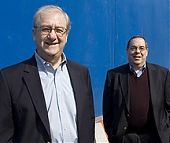
Matthew Pittinsky, (pictured above) CEO, Parchment also co-founded Blackboard Inc. With Parchment, his mission and passion is to unleash education credentials by unlocking the critical data they embody. “We are an education data company that works with institutions and corporations around the world helping people collect, promote, and share their education credentials in simple and secure ways,” he says. “Parchment is about ensuring that the hard work you’ve put into your education continues to work hard for you.”

Do you think college kids are lazy, slovenly, and couldn’t possibly be the entrepreneurs of the future? Think again. As Oliver St. John reports in an August USA Today article, thanks to some enterprising college students, undergrads can now outsource everything from grocery shopping to laundry and storing their dorm contents for the summer.

To read about these clever student entrepreneurs, click here.

K-12 education is also finding its way into the high-tech era. Dr. Peter Noonan knows that teaching kids to love to learn—through whatever means is necessary—is not just critical for their academic success.

It is helping to shape the careers they will have, and the adults they will become, says the former teacher, principal, assistant superintendent for Instructional Services, and now the superintendent of the City of Fairfax Schools in Northern Virginia.

“The notion of 21st century skills is incredibly relevant in terms of teaching students online, because our goal is to help them learn to problem-solve, think critically, and be a good and productive member of a team,” Noonan says. “The business world will certainly continue to get more global, and speed of technological change will continue to increase. Therefore, it is incumbent on educators to prepare students properly for the jobs of the future in many ways.”

One of the easiest ways to start, Noonan is convinced, is through digital texbooks. “The idea that a student should open a textbook and go to a page in a chapter for information, or head to the media center to do some research, is simply antiquated.”

Not surprisingly, digital textbooks are sweeping the nation. Around the country, school districts are quickly making the transition from traditional textbooks and paper-based instructional resources to Web-based instructional resource. These go far beyond just putting textbook files online.

When the Vail School District in Arizona opened Empire High School in Tucson in 2005, educators began the “Beyond Textbooks” initiative. It bought student laptops and online resources instead of traditional textbooks, which saved nearly $2,000 per high school student. “It’s not about printed versus digital, it’s about the entire metaphor of a textbook that’s essentially out of gas,” says its chief information officer, Matt Federoff, who likens the shift to purchasing songs from iTunes versus buying albums.

And when Arnold Schwarzenegger was governor of California, he championed the California Open Source Textbook Project, a collaborative, public/private undertaking that was created to address the high cost, content range, and consistent shortages of K-12 textbooks in California. The free, open-source digital versions are expected to save the state millions of dollars.

Not surprisingly, textbooks publishers are jumping on big opportunity. Players include Houghton Mifflin, Reed Elsevier, and Pearson. Leading the charge, though, is McGraw-Hill Education, which earned gross revenues in excess of $1.1 billion in 2011, making up about 40 percent of the $800 million textbook publishing industry.

Dan Caton, executive VP of the education division, says his company has an aggressive development plan for digital program development in all subject areas. “Our digital-tools for teachers includes online teacher editions, record-keeping, assessment, data analysis, and student grouping and support.” Undoubtedly, the use of digital textbooks will grow exponentially. With it be worth the investment?

What are the 5 things all entrepreneurs need to know about the future of education? We got great insight from TIME magazine reporter Annie Murphy Paul, author of the upcoming book, “Brilliant: The Science of Smart.” Find that here: Tips for Entrepreneurs.

Annie Murphy Paul: What Entrepreneurs Need to Know About Learning

By Annie Murphy Paul
Author and Journalist
Online: anniemurphypaul.com.

Entrepreneurs may be the world’s best learners. They figure out on the fly how to make their businesses succeed, discovering as they go what works and what doesn’t.

While most of them learned how to do what they do through experience, not in a classroom, lately the academy has come to them, making “entrepreneurial learning” the focus of empirical investigation.

Researchers show us the way.

Researchers at the Ningbo, China, campus of the University of Nottingham, for example, recently studied a group of successful Hong Kong entrepreneurs to find out how these individuals acquire new knowledge and skills.

Such independent businesspeople, the academics report, are voracious consumers of information: about the daily details of their companies, about the views of their employees and customers, about the practices of their competitors.

The entrepreneurs spend a lot of time thinking about the reasons for their successes and for their failures, always looking for ways to do better. Thomas Wing Yan Man, associate professor of entrepreneurship and innovation at the university and the leader of the study, concludes that successful entrepreneurs “are continually working on improving their entrepreneurial prowess through an active process of learning and reflection.”

In another study published earlier this year in the journal Entrepreneurship: Theory and Practice, Michael Morris of Oklahoma State University and his coauthors point out that for entrepreneurs, “learning is more than simply grasping and interpreting objective knowledge.”

By virtue of their close involvement and hands-on contact with their companies, entrepreneurs filter their professional experiences through their own feelings and values.

“Learning is not limited to what works and what does not” from a commercial point of view, notes Morris. “The entrepreneur is learning from his or her emotions, and about himself or herself,” even as he or she absorbs knowledge about the business.

This intensity can make for particularly powerful learning experiences, but it also means that entrepreneurs must take steps to maintain perspective and equilibrium.

What are successful entrepreneurs best at?

In a 2011 article in the journal Marketing Management, Karl Hellman and Robert S. Siegel write that the key is to identify and learn from the “anomaly”—the unexpected occurrence that can open into opportunity.

Whether you are an entrepreneur, or just want to innovate like one, here are five things these enterprising businesspeople have learned about learning:

1. Failure is information. Entrepreneurs tolerate and even welcome failure because it tells them something important: what doesn’t work. Trial and error—lots of error—is the only way to find out what’s effective.

2. Data is decisive. Entrepreneurs are obsessive about tracking and analyzing data because they know that the numbers hold insight: unexpected discoveries that can’t be made any other way.

3. People are resources. Entrepreneurs know that the information most vital to their businesses’ success isn’t written down in books or even on websites: it’s in people’s heads. So they’re always meeting, talking, and asking questions.

4. Change is the constant. Entrepreneurs don’t learn things once and then store it away. They are constantly updating and refining their knowledge, and when necessary, tossing aside the whole lot to adopt a new paradigm.

5. Work is play. Entrepreneurs are able to work superhuman hours with Herculean energy because, simply, it’s what they love to do. Dutiful competitors don’t stand a chance against the entrepreneur’s voracious appetite for information about the subject she considers the most interesting thing in the world: her business.

About Annie Murphy Paul

Annie Murphy Paul is a book author, magazine journalist, consultant, and speaker who helps people understand how we learn and how we can do it better. A contributing writer for TIME magazine, she writes a weekly column about learning for Time.com, and also blogs about learning at CNN.com, Forbes.com, MindShift.com, PsychologyToday.com, and HuffingtonPost.com.

Paul also contributes to The New York Times Magazine, The New York Times Book Review, Slate, and O, The Oprah Magazine, among many other publications.

She is the author of The Cult of Personality, a cultural history and scientific critique of personality tests, and of Origins, a book about the science of prenatal influences.

Paul is now at work on Brilliant: The New Science of Smart, to be published by Crown in 2013. For more infromation, visit anniemurphypaul.com.

Happy are those who dream dreams and are ready to pay the price to make them come true.”

– Leo Jozef Suenens

We must be willing to let go of the life we have planned so as to have the life that is waiting for us.”

– Joseph Campbell

No matter how difficult and painful it may be, nothing sounds as good to the soul as the truth.”

– Martha Beck, from "Leaving the Saints"

To find what you seek in the road of life, leave no stone unturned.”

– Edward Bulwer Lytton

Think of yourself as on the threshold of unparalleled success. A whole, clear, glorious life lies before you. Achieve! Achieve!”

– Andrew Carnegie

If you wish success in life, make perseverance your bosom friend, experience your wise counselor, caution your elder brother, and hope your guardian genius.”

– Joseph Addison

History is a relentless master. It has no present, only the past rushing into the future. To try to hold fast is to be swept aside.”

– John F. Kennedy

The good ideas are all hammered out in agony by individuals, not spewed out by groups.”

– Charles Brower, Advertising Hall of Fame

You only live once. But if you do it right, once is enough.”

– Mae West

You have enemies? Good. That means you’ve stood up for something, sometime in your life.”

– Winston Churchill

Instead of loving your enemies, treat your friends a little better.”

– Edgar W. Howe

There are risks and costs to a program of action. But they are far less than the long-range risks and costs of comfortable inaction.”

– JFK

The gem cannot be polished without friction; nor man perfected without trials.”

– Chinese proverb

We need to learn to set our course by the stars, not by the lights of every passing ship.”

– General Omar Bradley

You’ve got to be willing to crash and burn. If you’re afraid of failing, you won’t get very far.”

– Steve Jobs

The only person you are destined to become is the person you decide to be.”

– Ralph Waldo Emerson

Permanence, perseverance and persistence in spite of all obstacles distinguishes the strong soul from the weak.”

– Thomas Carlyle

Try not to become a man of success but rather to become a man of value.”

– Albert Einstein

The journey is the reward.”

– Greg Norman

Do not follow where the path may lead. Go, instead, where there is no path and leave a trail.”

– Ralph Waldo Emerson

Whosoever knows how to fight well is not angry. Whosoever knows how to conquer enemies does not fight them.”

– Lao Tzu, Tao Te Ching

Practice kindness all day to everybody and you will realize you’re already in heaven now.”

– Jack Kerouac

Opportunity is missed by most people because it is dressed in overalls and looks like work.”

– Thomas Edison

My task is really not to change myself but to become familiar with who I am.”

– Maureen Cook

Most people never pick up the phone and call. Most people never ask, and that’s what separates the people who do things from the people who just dream about them.”

– Steve Jobs

Running that first shop taught me business is not financial science; it’s about trading.”

– Anita Roddick, founder, The Body Shop

There is only one success – to be able to spend your life in your own way.”

– Christopher Morley

The awakening to the mystery of life is a revolutionary event; in it an old world is destroyed so that a new and better one may take its place.”

– J.J. Van Der Leeuw, The Conquest of Illusion

The follow-your-gut mentality of the entrepreneur has the potential to take you anywhere you want to go or run you right out of business.”

– Bill Rancic, "The Apprentice"

That man is richest whose pleasures are the cheapest.”

– Henry David Thoreau

A man who strikes first admits that his ideas have given out.”

– Chinese Proverb

Hope sees the invisible, feels the intangible, and achieves the impossible.”

– Helen Keller

Letting go of expectations is a ticket to peace. It allows us to ride over every crisis—small or large—like a beach ball on water.”

– Martha Beck

Our deepest wishes are whispers of our authentic selves. We must learn to respect them. We must learn to listen.”

– Sarah Ban Breathnach

If you would create something,
 you must be something.”

– Johann Wolfgang von Goethe

Education is the ability to listen to almost anything without losing your temper or your self-confidence.”

– Robert Frost

We are perfectionists. We are hungry to work all the time. We are entertained by every aspect of business and we never want to stop working.”

– Suzy Welch

Simplicity is the ultimate sophistication.”

– Leonardo da Vinci

If you do work that you love, and the work fulfills you, the rest will come.”

– Oprah Winfrey

No one is useless in this world who lightens the burden of another.”

– Charles Dickens

Darkness cannot drive out darkness: only light can do that. Hate cannot drive out hate: only love can do that.”

– Martin Luther King Jr.

As your desire is, so is your will. As your will is, so is your deed. As your deed is, so is your destiny.”

– Brihadaranyaka Upanishad

The important thing is not being afraid to take a chance. The greatest failure is to not try.”

– Debbi Fields, Mrs. Fields Cookies

If you want to be busy, keep trying to be perfect. If you want to be happy, focus on making a difference.”

– Lisa Earle McLeod

I may not be able to change what takes place, but I can always choose to change my thinking.”

– Michelle Sedas

Have the courage to follow your heart and intuition. They somehow know what you truly want to become.”

– Steve Jobs

I was taught at a very young age that you can do whatever you want to, but you have to make it happen — not just talk about it.”

– Kathleen Jo Ryan

Try not to become a man of success but rather try to become a man of value.”

– Albert Einstein

‎No one is useless in this world who lightens the burden of another.”

– Charles Dickens

That which does not kill us makes us stronger.”

– Friedrich Nietzsche

Be Inkandescent Magazine's Back Issues

Don’t miss the great advice our entrepreneurs have offered in the past. Click below to view our back issues.