• August 2010

Are you ready to take the risk?

RISK is the topic we tackle in the August issue of Be Inkandescent Business Magazine.

For inspiration, we turn to renowned writer and professor Leo F. Buscaglia, PhD, author of such classics as “Love,” “Personhood,” and “Living, Loving, and Learning,” who says: “The person who risks nothing, does nothing, has nothing, is nothing, and becomes nothing. He may avoid suffering and sorrow, but he simply cannot learn and feel and change and grow and love and live.”

As a PR, marketing, and publishing company that focuses on helping entrepreneurs grow their businesses, all of us at Inkandescent PR believe that Dr. Buscaglia was spot on in his assessment. In fact, everyone on our staff was curious to learn the answers to these questions about risk:

Are all entrepreneurs natural risk-takers? Does success in business equate to taking calculated risks? Or are most risk-takers simply daredevils who are willing to risk it all? Do entrepreneurs have a predisposition to being willing to take a risk? Is it a personality type? Can a willingness to take risks be learned?

As it turns out, the answers are personal and unique to each entrepreneur — although we did find some commonalities. Some of the 18 entrepreneurs who wrote the columns you see on this homepage are cautious about taking risks — including College Funding Coach Brock Jolly who explains that while he enjoys taking risks in some of areas of his life — that’s not the case with planning for the financial future of his clients. Immigration attorney Cynthia Hemphill outlines tactics for minimizing risks for performing artists who are having trouble obtaining U.S. visas. Career specialist recruiter Paige Rhodes suggests that job-changers carefully assess the risk ratio before making a move in today’s economic climate.

Other Be Inkandescent Magazine columnists are more willing to leap in and take a risk, including our Entrepreneur of the Month: Dr. Ben Carson. The world famous Johns Hopkins Children’s Center neurosurgeon — who separates conjoined twins for a living — says that taking a risk is a good thing, but only when you have no other choice. “If you are sailing along smoothly in your life and business, why rock the boat? But if the boat appears to be sinking, you might want to take your chances and jump into the water.”

Scroll down to read our interview with Dr. Carson, and learn more about his book, Take the Risk.

Before you do, consider this research study: Scientists at Copenhagen University found that people with high levels of the gratification brain hormone dopamine — and those with low sensitivity to it — tend to be greater risk takers and may be more prone to addictive behavior, drug abuse, and gambling.

Women, we learn from another study, are incredibly big risk takers by nature. According to research by the Simmons School of Management in Boston, not only do female managers take more risks than believed, but they should also more actively seek out credit for their boldness.

To all you dopamine-driven gutsy risk-taking leaders out there, we leave you with these sage words from President John F. Kennedy: “There are risks and costs to a program of action. But they are far less than the long-range risks and costs of comfortable inaction.”

Here’s to your success!
Hope Katz Gibbs — Editor & Publisher, Be Inkandescent Magazine

Illustration (above) by Michael Gibbs
www.michaelgibbs.com / www.mglenwood.com

Dr. Ben Carson tells us when to take a risk

AUGUST 2010 ENTREPRENEUR OF THE MONTH

Dr. Ben Carson, the world-famous neurosurgeon who separates conjoined twins at Johns Hopkins Children’s Center, is no stranger to risk. Read on to find out how he takes a calculated approach to determining which risks are worth taking in medicine, business, and life — and how you can, too!

By Hope Katz Gibbs
Editor & Publisher
Be Inkandescent Magazine

How risky is it to separate conjoined twins? Dr. Ben Carson, the director of pediatric neurosurgery at Johns Hopkins Children’s Center in Baltimore, says he doesn’t think about his work in those terms.

“You don’t go into a field that requires cracking people’s heads open or operating on something as delicate as the spinal cord unless you are comfortable with taking risks,” explains Carson in his latest book, “Take the Risk: Learning to Identify, Choose, and Live with Acceptable Risk.”

Previous books include “Think Big,” and “Gifted Hands,” which became a made-for-TV movie for TNT starring Cuba Gooding, Jr. Directed by Thomas Carter (Coach Carter). The film reveals Carson’s inspiring life story as a poor, inner-city youth who overcame great odds to become one of the world’s best surgeons, thanks to the love of his determined single mother (played by Kimberly Elise) and an unswerving faith.

Learning to Identify, Choose, and Live with Acceptable Risk

In “Take the Risk,” Carson packs the pages with gripping tales about some of the most complicated cases he’s worked on — including trying to separate the 29-year-old Iranian twins Ladan and Laleh Bijani, and successfully performing a risky hemispherectomy (the removal of one-half of the brain) on 4-year-old Maranda Francisco.

Carson’s book illustrates how his experiences have enabled him to move forward instead of being paralyzed by fear.

In it, the surgeon explains his belief that in our security-obsessed culture his attitude is unique, and that’s why he felt compelled to issue a wake-up call.

“I wanted to send a message to Americans that we’ve become a nation of yellow-bellies,” he tells The Connection. “What we’re buying, and what everyone is selling us, is the promise of security. Yet the only thing we can be sure of is that someday every one of us will die.”

Carson’s advice: “Don’t focus on how you might die, but consider how you should live.” Fortunately, he provides a prescription for success. The second half of his book outlines a simple assessment system he started using years ago, called the Best/Worst Analysis. (See Dr. Carson’s Tips for Entrepreneurs to learn more about that technique.)

A Little Background

Ben Carson was raised in poverty on the streets of urban Detroit. His mother Sonya was a teenager with little education and no professional training. But she was determined to raise Ben, and his older brother, Curtis (now an engineer), to be accomplished—and fearless.

It wasn’t easy. Their father left when the boys were young, so Sonya moved the family to Boston to live with her aunt and uncle. They attended a church school, and when Sonya was finally on her feet and able to move back to Detroit, Ben had fallen behind academically.

Although he had made a promise to himself at the age of 8 that he’d grow up to become a doctor, at 11 he was considered the “dumbest kid in the fifth grade.”

At the risk of alienating her sons, Sonya took away their TV privileges and instructed them to read two books a week, write a report and read it aloud to her (because she couldn’t read herself).

When Carson reached seventh grade, he was at the top of nearly every class. In the years that followed he also found ways to outsmart street thugs, his own bad temper and racism.

Carson’s Gifts

His ability to stay focused-and teach himself through books and determination eventually earned him a full scholarship to West Point, which he turned down to attend Yale University.

There, he met his future wife, Candy, and after graduation went on to attend the University of Michigan School of Medicine. Today, at 56, he performs 400 surgeries a year, holds more than 40 honorary doctorate degrees and has been named by the Library of Congress as one of 89 Living Legends.

“Being successful is simply a matter of making good choices by using our incredibly sophisticated brains,” says Carson. “We all have the means to analyze risks and decide which are worth taking and which should be avoided. That’s a simple but powerful prescription for life, love and success in a dangerous world.”

When should you take the risk?

Dr. Carson realizes that not everyone has the same risk threshold as he does. He also knows that in the case of separating Siamese twins, someone will likely die if the risk isn’t taken.

“But if things are going along smoothly, why would you risk making changes?” he reasons. “But if the boat appears to be sinking, it would probably be a good idea to jump into the water and try to get to safe ground.”

He believes this is true in all aspects of society — especially when it comes to the Health Care Reform Act.

“As a country, we aren’t going to make much progress if we take a status quo, ‘whatever will be,’ attitude to our laws and what is acceptable in society,” he says. “When it comes to having affordable health insurance that is accessible to all, we need to be proactive.”

As business owners, he believes, we all need to analyze the situation. “We need to ask what are the future implications for our organizations — not just to cover the employees we have today, but those we will hire in the future. As I understand it, health insurance is going to get much more expensive due to the additional requirements of this bill. The risk, in this case, is not carefully analyzing the situation. The sign of a good leader is to see something, recognize it, deal with it before it becomes a crisis.”

In fact, Dr. Carson is fleshing out his concern about the direction in which the country is going in his next book, In Blank We Trust, which will be published in 2011.

“As a nation, we seem to have forgotten our values and principles,” he says. “We are all so concerned about being politically correct and appeasing everyone that we have lost touch with who we are as a nation.

“Typically, this is what happens to societies before they decline. The new book is my attempt at issuing a wake up call to people. I want to tell them that they don’t have to be ashamed about who we are as a country. America has found a way to reach amazing pinnacles before others, and we shouldn’t throw that out.”

What decision is Dr. Carson struggling with today?

“I am trying to decide if I should buy a personal plane,” he shares. “I spend so much time flying around the country, and too much of that time is spent waiting in airports. I could be so much more efficient if I had my own airplane.”

To decide, he’s worked with his Best/Worst Analysis model.

“There is a part of me that thinks it’s too flamboyant, but there is another part that knows it is the logical thing to do,” he says. “Based on my own system, I’ll likely buy a plane in the next year.”

Click here to read Dr. Ben Caron’s Tips for Entrepreneurs.

Dr. Ben Carson shows us how to conduct a best case / worst case analysis

The Truth About Risk

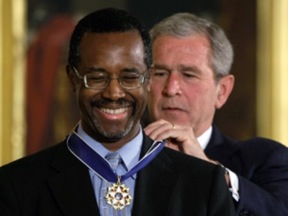
On June 19, 2008, Dr. Ben Carson received the nation’s highest civilian award, the Presidential Medal of Freedom, in a White House ceremony. He says that he’d never have achieved so much if he hadn’t known the what he calls “the truth about risk.”

He offers an example in chapter 5 of his book, “Take the Risk,” when he shares the poignant story of Bo-Bo Valentine, a 4-year-old girl who got hit by an ice cream truck and was near death when he met her.

What Dr. Carson Learned from Bo-Bo Valentine

“I first met Bo-Bo on a Monday morning, after she had been in laying comatose all weekend in the intensive care unit,” he writes, noting that he was told her pupils were responding to light, which was positive. Still, the resident in charge believed it was time to give up on her.

Dr. Carson explains that he gently lifted her eyelids, and found her eyes fixed and dilated. He knew he had to act fast if he was going to save her. En route to the operating room, they bumped into another surgeon who advised, “Don’t do it. You are wasting your time.”

“His response startled me, but I didn’t let it deter me,” Dr. Carson writes. ““There wasn’t time. Bo-Bo was still alive, and we had a chance, slight as it may be, to save her life. I didn’t rethink my decision. I was going to do the surgery.”

After two hours in the OR and more than a week spent comatose, Bo-Bo was alert and responsive.

“Within six weeks,” he shares, “she was a happy, normal, charming four-year-old girl again. I saw Bo-Bo recently, and she introduced me to her own little girl. That brief encounter was a wonderful reminder to me that experts don’t always have the last word on risk. Sometimes they only add to our doubt and confusion about the uncertainties and risks we face in life.”

Best Case / Worst Case Analysis: A Primer for Deciding When to Take a Risk

When wrestling with an important decision, Dr. Ben Carson suggests asking yourself these four questions:

1. What is the best thing that can happen if I do this?
2. What is the worst thing that can happen if I do this?
3. What is the best thing that can happen if I don’t do it?
4. What is the worst thing that can happen if I don’t do it?

“I think through these questions from my point of view, that of the patient, the parents and any other party involved, and by the time I’m done I know that I have considered just about every possible scenario and outcome,” Dr. Carson insists.

The More We Know, the More We Worry

Honored in 2009 by the Jackie Robinson Foundation for his contribution to mentoring African American youth, Dr. Carson (pictured here with fellow recipients Robin Roberts and Robert Redford) says he never ceases encouraging others to go for their dreams.

By outlining seven common sense “truths,” he helps us understand why it’s important not to let fear get in our way — including “Truth 2: The more we know the more we worry.”

“A couple of centuries ago,” he writes, “doctors didn’t understand the relationship between germs and disease; most of the populace throughout Western civilization believed more than one or two baths a year was excessive and might actually contribute to several dreaded illnesses.”

“Those who are quick to declare that we’re living today at a time of unique and unprecedented risk may need a little jogging of their memories, because our perspective has been and is greatly distorted by what I would diagnose as a serious case of societal amnesia,” he adds. “It’s no wonder that 90% of Americans say they feel less safe today than they did growing up. Yet the facts belie this sense of insecurity.”

He also believes that “Truth 3: A lot of risks aren’t worth the worry;” “Truth 5: Minimizing risk is often the best we can do,” and “Truth 7: Not all risks are bad.”

As a result, Dr. Carson feels strongly that each of us has to decide what the acceptable risks are.

A Prescription for Taking Good Risks

“When it comes to determining how you will react to any particular risk, you ought to think for yourself,” he concludes. “Wisdom is different from knowledge. Instead of losing ourselves in all the information before us, let’s exercise a little wisdom to us realize that life without risk would be dull.”

In closing, he offers five tips to help us make wise decisions.

1. Know yourself. Know your values, and what matters to you. It is the only way that you will know what risks are worth taking.

2. Whatever risk you take, be honest with yourself about your motives. And be honest with everyone who is going to be effected by your risk so they also know the pros and cons of the situation.

3. Do due diligence. Never jump into the pool unless you know how deep it is.

4. Be compulsive about analyzing the situation. Don’t take somebody else’s word for it. It’s your risk. Take responsibility for analyzing every angle.

5. Be brave. No one ever discovered anything great sitting under the olive tree waiting for it to happen, Carson concludes. “You have to go out there, be active, and shake the bushes if you want the birds to fly out.”

About Dr. Ben Carson

Benjamin S. Carson, Sr., M.D., had a childhood dream of becoming a physician.

Growing up in a single parent home and being challenged by dire poverty, poor grades, a horrible temper, and low self‐esteem appeared to preclude the realization of that dream, until his mother, with only a third‐grade education, challenged her sons to strive for excellence.

Young Ben persevered, and today is a full professor of neurosurgery, oncology, plastic surgery, and pediatrics at the Johns Hopkins School of Medicine, where he has directed pediatric neurosurgery at the Johns Hopkins Children’s Center for over a quarter of a century.

He became the inaugural recipient of a professorship dedicated in his name in May, 2008. He is now the Benjamin S. Carson, Sr., M.D. and Dr. Evelyn Spiro, R.N. Professor of Pediatric Neurosurgery.

Some career highlights include the first and only successful separation of craniopagus (Siamese) twins joined at the back of the head in 1987, the first completely successful separation of type‐2 vertical craniopagus twins in 1997 in South Africa, and the first successful placement of an intrauterine shunt for a hydrocephalic twin.

Although he has been involved in many newsworthy operations, he feels that every case is noteworthy — deserving of maximum attention. He is interested in all aspects of pediatric neurosurgery, and has a special interest in trigeminal neuralgia (a severe facial pain condition) in adults.

Dr. Carson holds more than 50 honorary doctorate degrees. He is a member of the Alpha Omega Alpha Honor Medical Society, the Horatio Alger Society of Distinguished Americans, and many other prestigious organizations.

He sits on the board of directors of numerous organizations, including Kellogg Company, Costco Wholesale Corporation, the Academy of Achievement, and is an Emeritus Fellow of the Yale Corporation, the governing body of Yale University. He was appointed in 2004 by President George W. Bush to serve on the President’s Council on Bioethics.

He is a highly regarded motivational speaker who has addressed various audiences from school systems and civic groups to corporations and the President’s National Prayer Breakfast.

In 2001, Dr. Carson was named by CNN and TIME Magazine as one of the nation’s 20 foremost physicians and scientists. That same year, he was selected by the Library of Congress as one of 89 “Living Legends” on the occasion of its 200th anniversary. He is also the recipient of the 2006 Spingarn Medal which is
the highest honor bestowed by the NAACP.

In February, 2008, Dr. Carson was presented with the Ford’s Theatre Lincoln Medal by President Bush at the White House. In June 2008, he was awarded the Presidential Medal of Freedom by the President, which is the highest civilian honor in the land.

Dr. Carson was recognized in November, 2008 by U.S. News & World Report and Harvard’s Center for Public Leadership, as one of “America’s Best Leaders.”

On February 7, 2009, the movie entitled “Gifted Hands: The Ben Carson Story” premiered on TNT and is based on his memoir. The movie was nominated in January 2010 for “Best Picture Made for Television” during the Critics Choice Awards.

“Gifted Hands: The Ben Carson Story” was the winner of the Epiphany Prize for “Best Television Movie” during the 2010 Movieguide Faith & Values Awards in February. The movie also won the 2010 NAACP Image Awards for “Outstanding
Television Movie, Mini‐Series, or Dramatic Special.”

Dr. Carson is also the president and co‐founder of the Carson Scholars Fund, which recognizes young people of all backgrounds for exceptional academic and humanitarian accomplishments. The Fund is currently operating in 34 states and the District of Columbia, and has awarded more than $3.9 million to nearly 4,000 scholars.

Are you willing to help other people succeed even when it’s not a requirement of your job to be of assistance?”

– Steven Schussler

Do not say, ‘why were the former days better than these,’ for it is not from wisdom that you ask this.”

– Ecclesiastes, 7:10

He who wants to tear down a house must be prepared to rebuild it.”

– African Proverb

You’ve got to be willing to crash and burn. If you’re afraid of failing, you won’t get very far.”

– Steve Jobs

The gem cannot be polished without friction; nor man perfected without trials.”

– Chinese proverb

Happy are those who dream dreams and are ready to pay the price to make them come true.”

– Leo Jozef Suenens

Permanence, perseverance and persistence in spite of all obstacles distinguishes the strong soul from the weak.”

– Thomas Carlyle

If we all did the things we are capable of doing, we would literally astound ourselves.”

– Thomas Edison

Only those who will risk going too far can possibly find out how far one can go.”

– T.S. Eliot

In the middle of difficulty lies opportunity.”

– Albert Einstein

Try not to become a man of success but rather try to become a man of value.”

– Albert Einstein

Outside of a dog, a book is man’s best friend. Inside of a dog it’s too dark to read.”

– Groucho Marx

Nothing in the world can take the place of persistence.”

– President Calvin Coolidge

You must have chaos within you, to create a dancing star.”

– Frederic Nietzsche

By your stumbling the world is perfected.”

– Sri Aurobindo

As your desire is, so is your will. As your will is, so is your deed. As your deed is, so is your destiny.”

– Brihadaranyaka Upanishad

Entrepreneurs are willing to roll the dice with their money or reputation on the line in support of an idea or enterprise.”

– Victor Kiam

Anything not worth doing well is not worth doing.”

– Warren Buffett

To be what we are, and to become what we are capable of becoming, is the only end of life.”

– Robert Louis Stevenson

Successful people are always looking for opportunities to help others. Unsuccessful people are always asking, ‘What’s in it for me?’”

– Brian Tracy

Nothing is a mistake. There’s no win and no fail. There’s only make.”

– Corita Kent

The fixity of a habit is generally in direct proportion to its absurdity.”

– Marcel Proust

As each woman realizes her power, she transforms the world.”

– Patrice Wynne, WomanSpirit Sourcebook

In three words I can sum up everything I’ve learned about life: it goes on.

– Robert Frost

Death is to lose the earth you know, for greater knowing; to lose the life you have, for greater life; to leave the friends you loved, for greater loving; to find a land more kind than home, more large than earth.”

– Thomas Wolfe

Pretend that every single person you meet has a sign around his or her neck that says, ‘Make Me Feel Important.’ Not only will you succeed in sales, you will succeed in life.”

– Mary Kay Ash

My task is really not to change myself but to become familiar with who I am.”

– Maureen Cook

Luck is what happens when preparation meets opportunity.”

– Seneca

Hope sees the invisible, feels the intangible, and achieves the impossible.”

– Helen Keller

The biggest flaw in our existing theory of capitalism lies in its misrepresentation of human nature.”

– Muhammad Yunus

That which grows fast withers as rapidly; that which grows slowly endures.”

– J.G. Holland, novelist

Do one thing every day that scares you.”

– Eleanor Roosevelt

Education is an admirable thing to have, but it is well to remember that nothing worth knowing can be taught.”

– Oscar Wilde

Never cut what you can untie.”

– Joseph Joubert

If you would create something,
 you must be something.”

– Johann Wolfgang von Goethe

When the power of love overcomes the love of power, the world will know peace.”

– Jimi Hendrix

The good ideas are all hammered out in agony by individuals, not spewed out by groups.”

– Charles Brower, Advertising Hall of Fame

No man will make a great leader who wants to do it all himself, or to get all the credit for doing it”

– Andrew Carnegie

Happiness is an attitude. We either make ourselves miserable, or happy and strong. The amount of work is the same.”

– Francesca Reigle

Always look at what you have left. Never look at what you have lost.”

– Robert H. Schuller

Tolerance and patience should not be read as signs of weakness. They are signs of strength.”

– The Dalai Lama

There’s nowhere you can be that isn’t where you’re meant to be…”

– John Lennon

We never know how high we are
 till we are called to rise;
 And then, if we are true to plan,
 Our statures touch the skies.”

– Emily Dickinson

Look at everything as though you were
seeing it either for the first or last time.
Then your time on earth will be filled with glory.”

– Betty Smith

We must be willing to let go of the life we have planned so as to have the life that is waiting for us.”

– Joseph Campbell

The great use of life is to spend it on something that will outlast it.”

– William James

If your success is not on your own terms, if it looks good to the world but does not feel good in your heart, it is not success at all.”

– Anna Quindlen

If you want to be busy, keep trying to be perfect. If you want to be happy, focus on making a difference.”

– Lisa Earle McLeod

When a dog runs at you, whistle for him.”

– Henry David Thoreau

Do you believe it is important to give back some portion of your wealth to support charitable causes?”

– Steven Schussler

Be Inkandescent Magazine's Back Issues

Don’t miss the great advice our entrepreneurs have offered in the past. Click below to view our back issues.