• November 2010

The Power of Giving

Since this is the month of Thanksgiving, in this issue of Be Inkandescent Magazine, we have taken the opportunity to celebrate the power and importance of giving.

Research shows that your brain actually lights up when you give, writes author Wendy Smith in Give a Little: How Your Small Donations Can Transform Our World. “Researchers at the National Institute of Neurological Disorders and Stroke found that something in our brains shaped by evolution allows us to feel joy when we do good things,” she says. “It’s a biological force.” Read our review.

Also in this issue, you’ll learn about several incredible non-profit organizations including the Maasai Girls Education Fund, The Center for Wilderness Safety, and the World Food Programme, which is run by our Truly Amazing Woman, Josette Sheeran.

The pièce de résistance of this issue is the November Entrepreneur of the Month, Robert Egger, the founder of the DC Central Kitchen, and author of the inspiring book, “Begging for Change.” He teaches us the dollars and sense of making non-profits responsive, efficient, and rewarding for all.

As industrialist and philanthropist Warren Buffett says: “Anything not worth doing well is not worth doing.”

Here’s to giving it your all.Hope Katz Gibbs
Editor & publisher, Be Inkandescent Magazine
Founder, Inkandescent Public Relations
Illustration (above) by Michael Gibbs, www.michaelgibbs.com

Nonprofit guru Robert Egger is "Begging for Change"

NOVEMBER 2010 ENTREPRENEUR OF THE MONTH

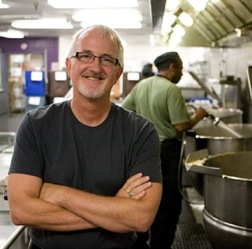
Robert Egger, founder of the DC Central Kitchen

By Hope Katz Gibbs

“Hello, my name is Robert and I’m a recovering hypocrite,” writes nonprofit advocate Robert Egger in the beginning of his book, “Begging for Change: The dollars and sense of making nonprofits responsive, efficient, and rewarding for all.”

The founder of the DC Central Kitchen, who among other leadership roles was tapped to clean up the beleaguered United Way National Capital Area as interim director back in 2002, is on a mission.

“I discovered soon after I started the DC Central Kitchen that winning my war — the war against hunger — wasn’t just about feeding more people or building more efficient kitchens,” Egger explains in his book. “Even if I spent the rest of my life raising hundreds of millions of dollars for the ‘cause,’ I realized that all the money would never end hunger. Hunger is tied to other battles. It’s about education, child care, job training, AIDS work, drug counseling, affordable housing, and health care.”

“It’s about what products we buy, how we donate our money, and how we vote,” he adds. “It’s about creating a system of self-sufficiency for two things: the people we’re assisting and the services we’re providing. It’s about building alliances with volunteers, donors, corporations, and other nonprofits that all share a unified vision of the future. It’s about smashing stereotypes, and fighting hypocrisy.”

“You probably think these observations should be filed under D for ‘Duh,’ but you’d be surprised how difficult they are to implement in the nonprofit world.”

And so, Eggers is begging for change.

“With the economy dragging and other factors at play, in the coming years there is going to be a dramatic thinning out in the nonprofit world,” Egger told members of the Arlington Chamber of Commerce, who gathered to hear him speak in October.

Nonetheless, he believes it’s time for nonprofit organizations to band together so they are a more powerful and organized group.

“If 30 nonprofit organizations got together and approached a bank to say they’d all transfer their accounts to that one institution — in exchange for a seat on the board of directors — they would influence change,” he says. “If they did the same with a PR firm, their mutual vendors, and other organizations that will help them grow, they’d influence change.”

Without this kind of cataclysmic shift, Egger can’t see things improving for many organizations in the nonprofit world that don’t have the financial security to plan long-term goals.

“The harsh reality is that some nonprofit organizations shouldn’t be running day to day,” he insists. “Many of them should go out of business, but because they’re in what’s called the ‘independent sector,’ neither the government nor Adam Smith’s Indivisible Hand has the power to make them go away. And that is the biggest problem of the sector: We are perpetually helping perpetually failing companies.”

How did Egger get on the giving bandwagon?

Egger wasn’t always an advocate for the poor. He started his career managing some of DC’s top nightclubs and restaurants. His 20s were spent rubbing elbows with some of the biggest names in show business — Emmylou Harris, Mel Torme, Rosemary Clooney, and the Ramones — acts he booked to entertain the champagne crowd that gathered for lobster and filet, and yes, maybe a little cocaine.

So, how did a man who dreamed of one day opening his own Rick’s Café Américain, å la the film Casablanca, start a nonprofit to help the hungry and homeless?

The idea began to form one evening in 1989 when he and his fiancé (now his wife) Claudia volunteered to feed the poor with Grace Church in Georgetown.

“It was the least snooty church we could find to get married at,” Egger explains. “Being the new kids in the congregation, we were encouraged to volunteer for something called Grate Patrol. But feeding the poor just wasn’t my thing. Then one day we got cornered by an organizer and had run out of excuses.”

By the end of the night, after seeing so many people line up for a warm bowl of lentil soup, Egger had questions. Lots of them.

“Was this all there was to it, handing out food?” he wondered. “Where were the social workers, the homeless shelter partners, the drug counselors, the incentives to help these people get out of their situation, or at least out of the friggin’ rain?”

Within weeks, the restaurateur that had previously been somewhat of a party animal, had a new dream. “My idea was simple,” he shares. “The [homeless] nonprofits could take unused food that was thrown away by restaurants and caterers, but instead of dropping it off at shelters, they could bring it to a ‘central kitchen’ where it could be chopped, combined, cooked, and then distributed.”

And then he added a twist. “Instead of just cooking it, the nonprofits could teach the homeless people the basics of food service as part of a modest job-training program. To me, it was Food Service 101, a logical flow that seemed evident.”

It was. But it took Egger years to convince officials, donors and even the homeless that he was on to something. Challenge after challenge, obstacle after obstacle, the stubborn entrepreneur persevered. Today, the DC Central Kitchen produces and distributes more than 4,000 meals a day — and his program is a model for what to do right in the nonprofit world. Egger is the recipient of the Oprah “Angel” award, the Bender Prize, and a Caring Award.
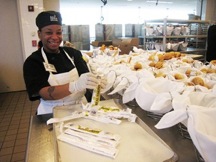
“Change happens by empowering and educating people,” Egger believes.

Aneika Muhammad (pictured right) is one of 10 students to intern at the Washington Convention Center, courtesy of the DC Central Kitchen’s Culinary Job Training program.

In October, she was arranging rolls and breadsticks for the Congressional Black Caucus dinner. By the end of November, she will be one of the 25 students who graduate from the 80th Culinary Job Training program hosted by the DC Central Kitchen.

“These internships enable students to spend a 40-hour work week under a mentoring chef in preparation for a real working environment,” Egger explains.

The weeklong internship is just one element of the Culinary Job Training program’s professional empowerment curriculum. Throughout the 12-week program, students participate in a bi-weekly class that covers topics such as networking etiquette, the value of jobs vs. a career, and how the culinary industry works. The students participate in mock interviews with DC Central Kitchen staff to help them perfect their interviewing skills.

Still, Egger knows there is more to be done. “We need to move beyond our 19th century concept of charity and usher in a 21st century model of change and reform for nonprofits,” he insists.

Click here to read Egger’s Tips for Entrepreneurs.

Robert Egger's insights for non-profits, businesses, volunteers, and donors

By Hope Katz Gibbs

I often start at the end when I’m reading a non-fiction book.

It’s the part of the writing exercise where the author lets his guard down and tells the reader what he really wanted to say all along.

And although Robert Egger’s entire book, “Begging for Change,” is as quick-witted and delicious as a champagne brunch on a sunny Sunday — the last pages give readers specific, practical advice on how to directly apply his experience and hard-won wisdom.

He concludes with this: “For the past 15 years I’ve been a recovering hypocrite, and every day I’ve been working and sweating to make Washington, DC a better hometown, a place for friends with friends. You too can do your part in your city or town, even with your family, your neighborhood, your office or congregation. Don’t be afraid to start small, or start with what you know best.”

Following are a dozen of his heartfelt tips, which come from a much longer list of his observations. For the full monty, buy his book.

Robert Egger’s rules for nonprofits

• Look at what you do. Are you a 19th century charity or a 21st-century community corporation?

• The recent downturn in public support for nonprofits isn’t about the economy. It’s about skepticism. The public has had enough with pity and platitudes. Americans want a plan.

• No matter how good you think you are, you aren’t. Everybody and everything can and will be boring. Always be open to opportunity and push farther and go faster and bring as many people along for the ride as possible.

• Find balance. Give yourself and your employees time to decompress. A nonprofit career is hard work, and everyone needs some space and time off.

Egger’s rules for businesses

• Think about how much money we would have in every community if we pooled money from the biggest nonprofits, corporate philanthropy, individual donations, and the local government. Throw in the volunteer hours of students, corporate employees, and retirees. Add all of this up. Now tell me, with all of these resources, what can’t we fix?

• Forget the three-year plan. Those are baby steps. Think Coltrane: Giant Steps. Imagine what your community will look like in 10 years. Combine your resources and your ideas, prioritize your plans, and work toward those goals as a true community.

• Don’t try to reinvent philanthropy. Just as there are too many nonprofits duplicating services, there are too many corporations and foundations duplicating philanthropic efforts. Philanthropy has to be tied to local politics and partners in the community. If the players are not in sync, their efforts won’t work.

• Don’t confuse marketing with making a difference. It’s more important for the public to respect you than it is for them to like you. The public wants more than feel-good imagery. They want action.

Egger’s rules for volunteers and donors

• Don’t feel guilty if you can’t fund every struggling or failing nonprofit. There are too many agencies chasing the same dollars, and the reality is we’d be stronger and more effective if many of them consolidated or went out of business.

• Americans give on average $1,600 a year to nonprofits. Would you invest that much in the stock market without doing research? Ask questions. Demand answers.

• Don’t scatter your donations. Philanthropy is spread across too many interests. Be selective and be generous, and fund the nonprofit you choose at a level that allows the organization to focus on the mission, not the money.

• Believe in the impossible. We have the power to make this an amazing society — if we work together. Be part of it. Make waves.

For more thoughts, read Robert Egger’s blog: www.robertegger.org

Click here to learn more about the DC Central Kitchen: www.dccentralkitchen.org

Do you believe it is important to give back some portion of your wealth to support charitable causes?”

– Steven Schussler

Successful people are always looking for opportunities to help others. Unsuccessful people are always asking, ‘What’s in it for me?’”

– Brian Tracy

If you look at what you have in life, you’ll always have more.
 If you look at what you don’t have in life, you’ll never have enough.”

– Oprah Winfrey

Whatever you do may seem insignificant, but it is most important that you do it.”

– Gandi

Outside of a dog, a book is man’s best friend. Inside of a dog it’s too dark to read.”

– Groucho Marx

That man is richest whose pleasures are the cheapest.”

– Henry David Thoreau

We are all of us born with a letter inside us, and that only if we are true to ourselves, may we be allowed to read it before we die.”

– Douglas Coupland

A lot of people have ideas, but few decide to do something about them now. Not next week. But today.”

– Nolan Bushnell, founder, Atari

It is only with the heart that one can see rightly,
 what is essential is invisible to the eye.”

– Antoine de Saint-Exupéry

I find out what the world needs, then I proceed to invent.”

– Thomas Edison

Many people prefer to play it safe when it comes to business matters. Are you willing to take risks in the pursuit of entrepreneurial success?”

– Steven Schussler

Entrepreneurs are willing to roll the dice with their money or reputation on the line in support of an idea or enterprise.”

– Victor Kiam

Tell me, what is it you plan to do with your one wild and precious life?”

– Mary Oliver

Normal day, let me be aware of the treasure you are. 
Let me not pass you by in quest of some rare and perfect tomorrow.”

– Mary Jean Irion

Once you find something you love to do, be the best at doing it.”

– Debbi Fields, Mrs. Fields Cookies

To follow, without halt, one aim: There’s the secret of success.”

– Anna Pavlova

There are risks and costs to a program of action. But they are far less than the long-range risks and costs of comfortable inaction.”

– JFK

Some things are destined to be—it just takes us a couple of tries
to get there.”

– J.R. Ward, Lover Mine

This is the age when magical technologies make more and more radically fun ideas plausible, even easy. You’re only limited by your creativity.”

– Martha Beck

Remember that it’s okay to ask for help when you’re stumped, because sometimes you really can’t be expected to handle everything alone.”

– Martha Beck

Happy are those who dream dreams and are ready to pay the price to make them come true.”

– Leon Joseph Suenens

‎Excellence is to do a common thing in an uncommon way.”

– Booker T. Washington

4oz tequila + 1oz TripleSec + 2oz lime juice + 1oz simple syrup (sugar=water), 1 cup crushed ice. Shake + dance around the kitchen.

– Avenida Margarita

Part of your destiny is to live in the zone of maximum satisfaction.”

– Martha Beck

The curious paradox is that when I accept myself just as I am, then I can change.”

– Carl Rogers

The mind is everything. What you think, you become.”

– Buddha

The young man knows the rules, but the old man knows the exceptions.”

– Oliver Wendell Holmes Jr., U.S. Supreme Court justice

The real voyage of discovery consists not in seeking new lands, but in seeing with new eyes.”

– Marcel Proust

If you want to be busy, keep trying to be perfect. If you want to be happy, focus on making a difference.”

– Lisa Earle McLeod

Our deepest wishes are whispers of our authentic selves. We must learn to respect them. We must learn to listen.”

– Sarah Ban Breathnach

If you wish success in life, make perseverance your bosom friend, experience your wise counselor, caution your elder brother, and hope your guardian genius.”

– Joseph Addison

As each woman realizes her power, she transforms the world.”

– Patrice Wynne, WomanSpirit Sourcebook

It is not the strongest of the species that survives, nor the most intelligent, but the one most responsive to change.”

– Charles Darwin

The only dream worth having is to live while you’re alive and die only when you’re dead.”

– Arundhati Roy

Opportunity is missed by most people because it is dressed in overalls and looks like work.”

– Thomas Edison

Let yourself be silently drawn by the strange pull of what you really love.”

– Jalaluddin Rumi

Only those who will risk going too far can possibly find out how far one can go.”

– T.S. Eliot

There is little success where there is little laughter.”

– Andrew Carnegie

That which grows fast withers as rapidly; that which grows slowly endures.”

– J.G. Holland, novelist

Most people never pick up the phone and call. Most people never ask, and that’s what separates the people who do things from the people who just dream about them.”

– Steve Jobs

Instead of loving your enemies, treat your friends a little better.”

– Edgar W. Howe

The good ideas are all hammered out in agony by individuals, not spewed out by groups.”

– Charles Brower, Advertising Hall of Fame

The follow-your-gut mentality of the entrepreneur has the potential to take you anywhere you want to go or run you right out of business.”

– Bill Rancic, "The Apprentice"

Anything not worth doing well is not worth doing.”

– Warren Buffett

Spend the afternoon. You can’t take it with you.”

– Annie Dillard

Letting go of expectations is a ticket to peace. It allows us to ride over every crisis—small or large—like a beach ball on water.”

– Martha Beck

The fixity of a habit is generally in direct proportion to its absurdity.”

– Marcel Proust

Always be on the lookout for the presence of wonder.”

– E.B. White

Who cares if my glass is half empty or half full; I still have something to drink.”

– Optimism rules

You can only become truly accomplished at something you love. Don’t make money your goal. Instead, pursue the things you love doing.”

– Maya Angelou

Be Inkandescent Magazine's Back Issues

Don’t miss the great advice our entrepreneurs have offered in the past. Click below to view our back issues.