• January 2010

Welcome to BE INKANDESCENT

Welcome to Be Inkandescent Magazine,” the monthly online magazine for entrepreneurs, by entrepreneurs. Each month, our online publication will bring insights and observations from entrepreneurs in a variety of industries ranging from health care and human resources to books, education, finance, leadership skills, management tools, real estate, restaurants, wine, and more.

Each month we pick a theme that we believe will inspire, educate and entertain our readers. Past topics have included The Business of Happiness, Social Entrepreneurship, and Going Global.

In each issue, we also spotlight an Entrepreneur of the Month.. These business owners exemplify what it means to take risks, overcome challenges, and lead a team to success. He or she offers Tips for Entrepreneurs, and our monthly columnists share their thoughts, ideas and perspectives on the topic of the month.

We invite every entrepreneur to come up with stories that might be of interest to our audience and contact us with ideas. After all, the goal of any company is to have more people know about their products and services. We’d love to partner with you to spread the word.

Here’s to your success! — Hope Katz Gibbs
publisher, Be Inkandescent
president & founder, Inkandescent Public Relations

We Clear the Clutter With Organizational Expert Julie Morgenstern

JANUARY 2010 ENTREPRENEUR OF THE MONTH:
JULIE MORGENSTERN

Dubbed the “queen of putting people’s lives in order” by USA Today, Julie Morgenstern is an organizational and time management expert, business productivity consultant, and nationally renowned speaker. She’s also a New York Times bestselling author, having published five books that are reference guides featuring techniques and observations culled from her 20 years of experience as a consultant to individuals and companies.

She founded Julie Morgenstern Enterprises in 1989, and her common-sense approach to getting, and staying, organized has attracted the attention of Oprah Winfrey. In fact, in the last decade she appeared as a guest on Oprah nine times.

She has also appeared on CNN, The Today Show, CBS This Morning, and Good Morning America, and has been quoted in The New York Times, and the Wall Street Journal. Julie was also a monthly contributor to O, The Oprah Magazine. Her new monthly column premiered in the March 2009 issue of Redbook.

WHAT SHE DOES: The art of organization

Getting organized is a way of life for Julie and her team of trained organizational experts who work one-on-one with a wide range of clients to help them organize a home, office or schedule.

They “organize from the inside out,” which means her team needs to understand not just the goal of the project, but how the person in need of organizational therapy thinks and operates.

Once Julie’s team works their magic, an organization system is in place for the client that is easy to maintain because it is based on their unique goals, natural style and habits. For business groups, they design a system that is organic to the work culture, and easy for each individual to follow.

Satisfied clients include top managers at Time Warner, the CEO of Champion Health Associates, a professor at the Tuck School of Business, the owner of a Media Company in NYC, a documentary filmmaker, and countless freelancers, stay-at-home moms — and many entrepreneurs who know they need to be organized to be effective.

The bottom line, says Julie, is that in today’s “get it done yesterday” culture, being disorganized is a universal dilemma.

The Wall Street Journal published a story a few years ago with data indicating that the average U.S. executive wastes one hour per day searching for missing information in messy desks and files,” Julie explains. “The National Soap and Detergent Association assessed recently that getting rid of excess clutter would eliminate 40% of the housework in the average home. And 47% of the employees polled at the Connecticut-based work / life balance company LifeCare said time management was the number one source of stress in their lives.”

But there is a solution. Julie says it all starts with a plan.

HOW SHE DOES IT: SHED your stuff

Of course, she realized early on that she didn’t have the time to personally organize every business and private home in the country — or even her home base of New York City. So she began writing self-help books to aid the chronically disorganized in their quest to have a place for everything.

Her first title was published the first year she was in business: Organizing From the Inside Out: The Foolproof System for Organizing Your Home, Your Office and Your Life. She released a pack of handy organizational cards based on the book in 2002. Later that year came a sequel for organizationally challenged teens that Julie wrote with her daughter: Organizing From the Inside Out for Teens.

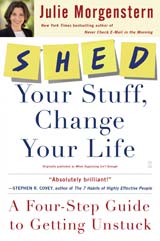
In 2004 came Time Management from the Inside Out, followed by Never Check E-mail in the Morning in 2005. In 2009 she released, SHED Your Stuff, Change Your Life.

WHY SHE DOES IT: A business born of necessity

Back in 1989, the year she started the business, Julie was working in theater and on the brink of divorce with three-year-old daughter Jessi to support.

“I had no money to speak of, but I knew that if I did nothing else I had to get organized,” she explains. “I was never one of those meticulous people, but I figured that if I could get myself organized — mind, body and apartment office — that I could do the same for others.”

She borrowed $100 from her neighbor Zoe, and took out a $26 ad in the publication that she knew would reach her target audience — New York’s favorite publication for parents, Big Apple Parent.

“Back in the late 1980s, everyone I knew kept it around for months,” Julie adds. “It was the go-to magazine for educated, dual-income families looking for parenting advice. I figured that was the place where I’d find my first clients.”

She was right. The ad, and the business cards and letterhead she bought with the rest of the $100 loan, turned into her first $500 job. She took $450 of it and bought a display ad in Big Apple Parent, and that led to dozens of other jobs, a staff, awards, speaking engagements, corporate training programs, the Organizing Institute — and her five books.

Her philosophy in SHED Your Stuff, in fact, is her guiding principle in fighting clutter, over-scheduling and breaking bad habits. SHED, she explains, is an acronym for Separate treasures, Heave the rest, Embrace identity from within, and Drive yourself forward. The book not only offers logical advice — but also includes easy-to-use timelines, thoughts on how to live in the moment, and quizzes and work sheets to teach how to shake free of the old, and take small steps toward creating the new clutter-free you.

Julie admits you may miss certain possessions or habits, “but the mental and physical space you gain from ridding your closet of decades old shoes and your drawers and filing cabinets of ancient memos and mementos will allow you to move forward. Honestly, who doesn’t want to do that?” — By Hope Katz Gibbs, publisher, Be Inkandescent

Click here to read her Tips for Entrepreneurs.

Organization Rules: 5 Ways to Achieve Business Success

Tips from Julie Morgenstern, renowned author, organizational guru, and owner of Julie Morgenstern Enterprises

1. Follow Eleanor Roosevelt’s sage advice: “Do not be afraid of mistakes, providing you do not make the same one twice.”

Julie says: “I live by this adage — except when I was worried about money and made the same mistake twice of taking on a client who I knew would be incredibly difficult. I didn’t listen to that little voice in my head that told me not to take on a client sure to give me grief and refuse to pay the bill.”

“I took her on anyway, and boy did I pay the price,” she laments. “It didn’t happen again until years later when I had a large staff working for me, and again I was concerned about making payroll. “I didn’t listen to that voice, and paid the price. But I made a pact that whenever I heard it again I’d see a big red flag with the words printed on it, ‘This one won’t pay.’”

2. Think like a consumer, and you will know what to do.

Julie explains: “When I was first starting out, I made an appointment with the Service Corps of Retired Executives (SCOREwww.score.org), and asked how to price my services. My advisor told me to see what others in my industry were charging, and then charge $10 more.”

“I thought that was crazy, until he explained people have a ‘designer tag mentality.’ They believe the most expensive sweater or diamond or lawyer or doctor is the best, and who doesn’t want to own or work with the best?”

For her first job she charged the industry standard — $25-$50, at the time. But on the second job, with a little experience under her belt, she knew her service was valuable and charged $60. The customer didn’t blink. “Once I realized that she felt that way about pricing, I began putting myself in the shoes of my customers in every decision I made — and everything fell into place.”

Of course, in today’s teetering economy that philosophy is being tested. “But there is a sweet spot in pricing. Don’t go too high, but don’t go too low either. If you are clear about not underselling yourself, you’ll find the happy medium.”

3. Establish core values for your company, and stick to them.

Julie believes: “I want every project I touch to be valuable and useful for the consumer, so I never launch a new product, service or idea without first thoroughly testing it. I hate when I buy something that is half-baked, and never want to do that to my clients. It’s one of my core values, and I take pride in that.”

4. Business solutions should come from your bones.

Julie says: “I know some serial entrepreneurs who come up with businesses, or products, based on a thorough analysis of the market. They see a need, and fill it. It’s an intellectual pursuit for them, and plenty of people are successful using this approach. For me, I have to feel it in my bones.”

That’s how she knew how to begin her business, she says, write her books, establish her corporate training program, and create her Organizing Institute. “I’m one of those intuitive people who gets gut feelings about things. If I don’t feel it, I can’t do it. My advice to others who are instinctive is to follow that. It has never led me astray.”

5. Hire people who are as good in their fields as you are in yours.

Julie admits: “This is a tough one to master, because most entrepreneurs — especially those just starting out — want to do everything themselves. Or they think they don’t have the money to hire anyone to help them.”

This is a classic mistake, Julie says, for there are three core skills that every entrepreneur must have: the ability to develop useful products and services, financial management skills, and marketing savvy.

“It’s very rare for any one business person to have adequate doses of all three,” Julie believes. “It took me a long time to learn this, and my advice to other entrepreneurs is to take your time building your team — but do build one.”

“Not only do you need the emotional support, but having other professionals take on some of the important tasks frees you up to do what you love to do and what you do best.”

“After all, being able to do that one thing is why you went into business for yourself in the first place.”

My job is my hobby. I come to work to play.”

– Uli Becker, president, Reebok International

If you have built castles in the air, your work need not be lost; that is where they should be. 
Now put foundations under them.”

– Henry David Thoreau

Education is the ability to listen to almost anything without losing your temper or your self-confidence.”

– Robert Frost

In three words I can sum up everything I’ve learned about life: it goes on.

– Robert Frost

Do not be afraid of mistakes, providing you do not make the same one twice.”

– Eleanor Roosevelt

Don’t follow, lead. Don’t copy, create. Don’t start, finish. Don’t sit still, move. Don’t fit in, stand out. Don’t sit quietly, speak up. (Not all the time, sure, but more often.)”

– Seth Godin

By your stumbling the world is perfected.”

– Sri Aurobindo

With ordinary talents and extraordinary perseverance, all things are attainable.”

– Sir Thomas Fowell Buxton

Letting go of expectations is a ticket to peace. It allows us to ride over every crisis—small or large—like a beach ball on water.”

– Martha Beck

Do you believe it is important to give back some portion of your wealth to support charitable causes?”

– Steven Schussler

Do you have the desire to create something new; the strength of conviction to believe your creation will be successful, and the reservoir of energy necessary to thrust it into the marketplace?”

– Steven Schussler

Whatever you do may seem insignificant, but it is most important that you do it.”

– Gandi

An entrepreneur tends to bite off a little more than he can chew hoping he’ll quickly learn how to chew it.“


– Roy Ash, co-founder of Litton Industries

No matter how difficult and painful it may be, nothing sounds as good to the soul as the truth.”

– Martha Beck, from "Leaving the Saints"

He who wants to tear down a house must be prepared to rebuild it.”

– African Proverb

Don’t judge each day by the harvest you reap, but by the seeds you plant.”

– Robert Louis Stevenson

Some things are destined to be—it just takes us a couple of tries
to get there.”

– J.R. Ward, Lover Mine

Success is the necessary misfortune of life, but it is only to the very unfortunate that it comes early.”

– Anthony Trollope

Pain is inevitable. Suffering is optional.”

– Dalai Lama

Happy are those who dream dreams and are ready to pay the price to make them come true.”

– Leon Joseph Suenens

Education is not the filling of a pail, but the lighting of a fire.”

– William Butler Yeats

Challenge is a dragon with a gift in its mouth. Tame the dragon and the gift is yours.”

– Noela Evans

If people like you they’ll listen to you; if they trust you, they’ll do business with you.”

– Zig Ziglar

You often meet your fate on the road you take to avoid it.”

– Goldie Hawn

There are children playing in the street who could solve some of my top problems in physics, because they have modes of sensory perception that I lost long ago.”

– J. Robert Oppenheimer

If you would create something,
 you must be something.”

– Johann Wolfgang von Goethe

If it isn’t good, let it die. If it doesn’t die, make it good.”

– Ajahn Chah

I find out what the world needs, then I proceed to invent.”

– Thomas Edison

If my mind can conceive it, and my heart can believe it, I know I can achieve it.”

– Jesse Jackson

The music is all around us. All you have to do is listen.”

– August Rush

But all the while I was alone, the past was close behind, I seen a lot of women, but she never escaped my mind, and I just grew, tangled up in blue.”

– Bob Dylan

The best reason to start an organization is to create a product or service to make the world a better place.”

– Guy Kawasaki

The critical ingredient is getting off your butt and doing something.”

– Nolan Bushnell, founder, Chuck E. Cheese's

Patience and perseverance have a magical effect before which obstacles vanish.”

– John Quincy Adams

Entrepreneurs are willing to roll the dice with their money or reputation on the line in support of an idea or enterprise.”

– Victor Kiam

Hold fast to dreams, for if dreams die, life is a broken-winged bird that cannot fly. Hold fast to dreams, for when dreams go, life is a barren field frozen with snow.”

– Langston Hughes

The good ideas are all hammered out in agony by individuals, not spewed out by groups.”

– Charles Brower, Advertising Hall of Fame

The important thing is not being afraid to take a chance. The greatest failure is to not try.”

– Debbi Fields, Mrs. Fields Cookies

A great secret of success is to go through life as a man who never gets used up.”

– Albert Schweitzer

Sometimes the dreams that come true are the dreams you never even knew you had.”

– Alice Sebold, The Lovely Bones

As your desire is, so is your will. As your will is, so is your deed. As your deed is, so is your destiny.”

– Brihadaranyaka Upanishad

No man will make a great leader who wants to do it all himself, or to get all the credit for doing it”

– Andrew Carnegie

Many people prefer to play it safe when it comes to business matters. Are you willing to take risks in the pursuit of entrepreneurial success?”

– Steven Schussler

Confidence is the most important thing you can teach someone… if you can teach them confidence, you don’t have to teach them anything else.”

– Vin Diesel

You take your life in your own hands, and what happens?
 A terrible thing: no one to blame.”

– Erica Jong

A man is a success if he gets up in the morning and goes to bed at night and in between does what he wants to do.”

– Bob Dylan

Spend the afternoon. You can’t take it with you.”

– Annie Dillard

Death is to lose the earth you know, for greater knowing; to lose the life you have, for greater life; to leave the friends you loved, for greater loving; to find a land more kind than home, more large than earth.”

– Thomas Wolfe

Do one thing every day that scares you.”

– Eleanor Roosevelt

Entrepreneurs willingly assume responsibility for the success or failure of a venture and are answerable for all its facets.”

– Victor Kiam

Be Inkandescent Magazine's Back Issues

Don’t miss the great advice our entrepreneurs have offered in the past. Click below to view our back issues.